Pont du Gard
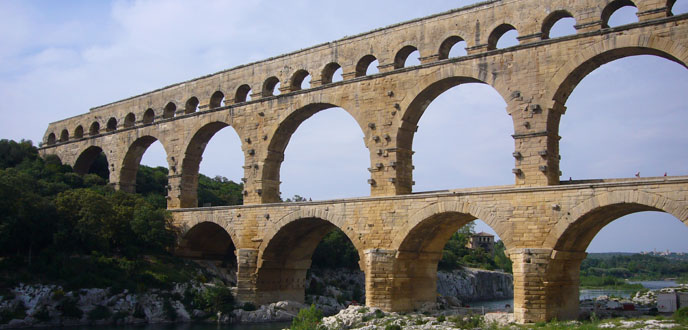


Pont du Gard is a three tiered aqueduct constructed by the Romans during the 1st Century AD to carry water as a part of a larger aqueduct from the Uzes area down to Nimes (approximately 31 miles long). The structure spans the Gardon River and is 45 yards high, and the longest level is 300 yards long.
The aqueduct's stones - some of which weigh up to 6 tons - were precisely cut to fit perfectly together eliminating the need for mortar. The masonry was lifted into place by block and tackle with a massive human-powered treadmill providing the power for the winch. A complex scaffold was erected to support the aqueduct as it was being built. The face of the aqueduct still bears the mark of its construction, in the form of protruding scaffolding supports and ridges on the piers which supported the semicircular wooden frames on which the arches were constructed. It is believed to have taken about three years to build, employing between 800 and 1,000 workers.
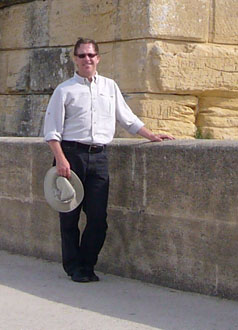
The original structure did not include the span on which we are walking; this "new" span was added in 1743. The structure has been restored at least four times since the 18th century and is now a UNESCO World Heritage Site.